
Care before counting
SAWAB’s impact is reflected in sustained programmes, long-term follow-up and care systems strengthened over time.
Impact
SAWAB’s impact is visible in programmes sustained over time, communities revisited, clinicians trained and care systems strengthened.
Return to SAWAB
How impact is understood
Three principles guide how SAWAB reads change across time, institutions and communities.
SAWAB’s impact is reflected in sustained programmes, long-term follow-up and care systems strengthened over time.
Long follow-up periods, repeated community engagement and ongoing medical education connect immediate care with durable learning.
Training non-psychiatric clinicians and working through existing community institutions expands the reach of informed mental-health care.
Work over time
Selected milestones and contributionsNon-psychiatric clinicians, medical trainees and frontline doctors were trained to identify and manage common mental disorders.
Kaz de Jong of MSF Amsterdam inaugurated Kashmir’s community mental-health programme at SKICC.
SAWAB’s public-interest litigation drew attention to inadequate psychiatric-care facilities serving Kashmir, Ladakh and adjoining areas of Jammu province.
A sustained follow-up of survivors of the February 2005 snowstorm has continued for two decades, combining care with disaster and trauma research.
Continuing Medical Education events in September 2025 reflected SAWAB’s continuing emphasis on evidence, knowledge sharing and capacity building.
Impact in public record
Independent reporting places SAWAB’s programmes beside the wider mental-health landscape in Kashmir.
Morning Kashmir
Kashmir Vision
Kashmir Life
Al Jazeera
In the public record
Archive reporting helps place today's work in context: rising demand, limited infrastructure and a generation living with prolonged stress.
Explore the full press archiveA contemporaneous account of the scale of need, limited specialist capacity and the growing demand for district-level mental-health services.
An early record of rising patient numbers, crowded wards and the need for trained staff, public awareness and humane mental-health care.
An interview on the emotional consequences of prolonged uncertainty for children and young people, and the role of listening, support and resilience.
A systems story
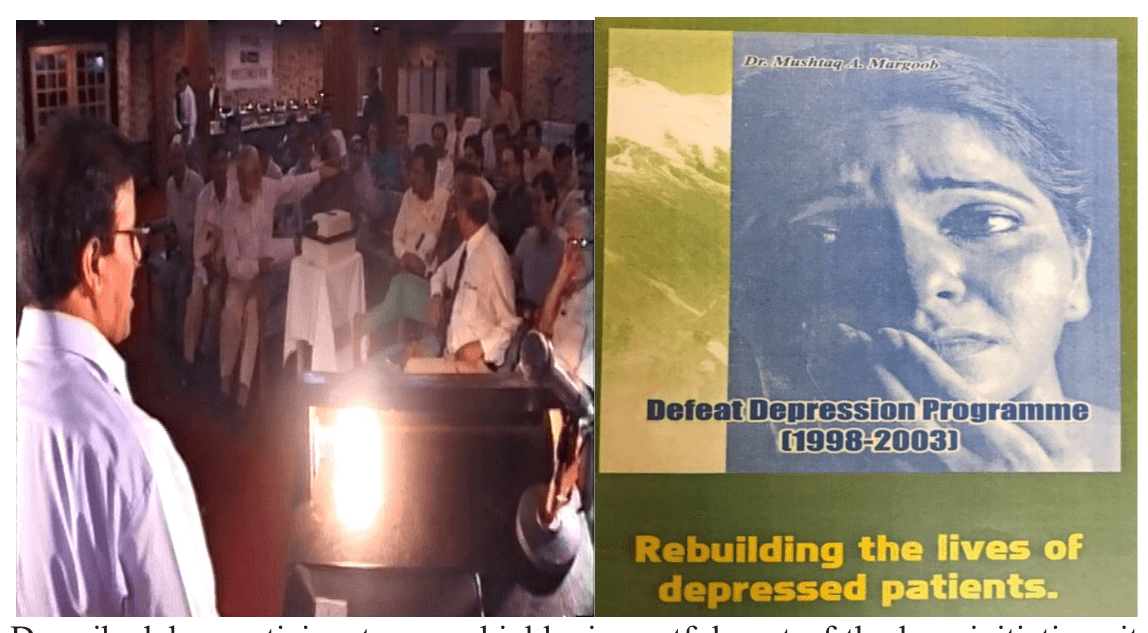
The Defeat Depression Programme trained faculty, medical trainees and frontline doctors to identify and manage common mental disorders. Its significance was not a headline statistic, but the strengthening of the general healthcare system’s ability to respond.
Explore academic work